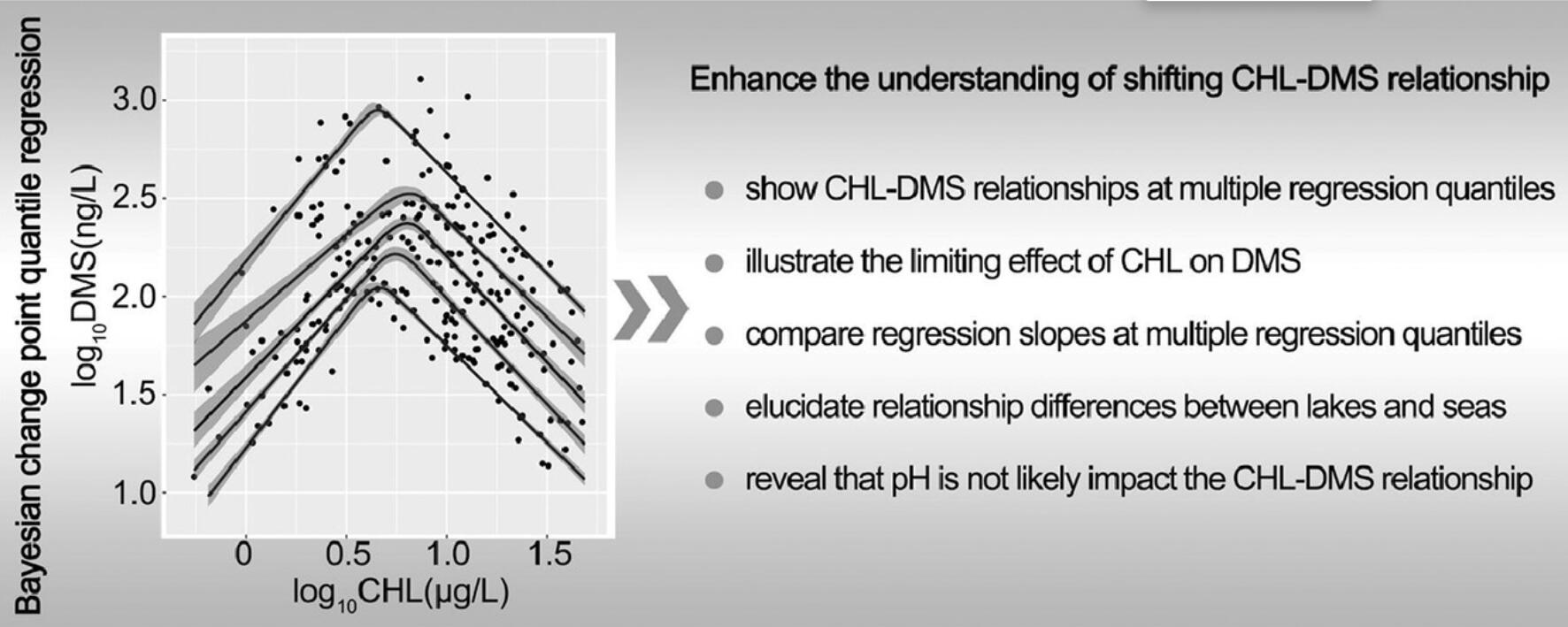
Dimethyl sulfide (DMS) serves as an anti-greenhouse gas, plays multiple roles in aquatic ecosystems, and contributes to the global sulfur cycle. The chlorophyll a (CHL, an indicator of phytoplankton biomass)-DMS relationship is critical for estimating DMS emissions from aquatic ecosystems. Importantly, recent research has identified that the CHL-DMS relationship has a breakpoint, where the relationship is positive below a CHL threshold and negative at higher CHL concentrations. Conventionally, mean regression methods are employed to characterize the CHL-DMS relationship. However, these approaches focus on the response of mean conditions and cannot illustrate responses of other parts of the DMS distribution, which could be important in order to obtain a complete view of the CHL-DMS relationship. In this study, for the first time, we proposed a novel Bayesian change point quantile regression (BCPQR) model that integrates and inherits advantages of Bayesian change point models and Bayesian quantile regression models. Our objective was to examine whether or not the BCPQR approach could enhance the understanding of shifting CHL-DMS relationships in aquatic ecosystems. We fitted BCPQR models at five regression quantiles for freshwater lakes and for seas. We found that BCPQR models could provide a relatively complete view on the CHL-DMS relationship. In particular, it quantified the upper boundary of the relationship, representing the limiting effect of CHL on DMS. Based on the results of paired parameter comparisons, we revealed the inequality of regression slopes in BCPQR models for seas, indicating that applying the mean regression method to develop the CHL-DMS relationship in seas might not be appropriate. We also confirmed relationship differences between lakes and seas at multiple regression quantiles. Further, by introducing the concept of DMS emission potential, we found that pH was not likely a key factor leading to the change of the CHL-DMS relationship in lakes. These findings cannot be revealed using piecewise linear regression. We thereby concluded that the BCPQR model does indeed enhance the understanding of shifting CHL-DMS relationships in aquatic ecosystems and is expected to benefit efforts aimed at estimating DMS emissions. Considering that shifting (threshold) relationships are not rare and that the BCPQR model can easily be adapted to different systems, the BCPQR approach is expected to have great potential for generalization in other environmental and ecological studies.