


• Home
  • About Us
    • Brief Introduction
    • Address from the Director
    • Directors
    • Organization
    • IUE in Media
  • Scientists
    • Academicians
    • Professors
    • Associate Professors
  • Research
    • Research Divisions
    • Research Progress
  • Education
    • Admission
    • Study at IUE
    • Scholarships
  • INT'L Cooperation
    • INT'L Cooperation News
    • Partnership
  • Papers
  • Join Us
    • Job Opportunities
    • PIFI
      • What's PIFI
Contact Us   |   Sitemap   |   CAS   |   中文
  • Home
  • About Us
    • Brief Introduction
    • Address from the Director
    • Directors
    • Organization
    • IUE in Media
  • Scientists
    • Academicians
    • Professors
    • Associate Professors
  • Research
    • Research Divisions
    • Research Progress
  • Education
    • Admission
    • Study at IUE
    • Scholarships
  • INT'L Cooperation
    • INT'L Cooperation News
    • Partnership
  • Papers
  • Join Us
    • Job Opportunities
    • PIFI

Papers

  • HomePapers
  • Papers
    Spatial-temporal Characteristics and Source Apportionment of Ambient VOCs in Southeast Mountain Area of China
    JI Xiaoting; XU Ke; LIAO Dan; CHEN Gaojie; LIU Taotao; HONG Youwei * ; DONG Sijun; CHOI Sung-Deuk; CHEN Jinsheng *

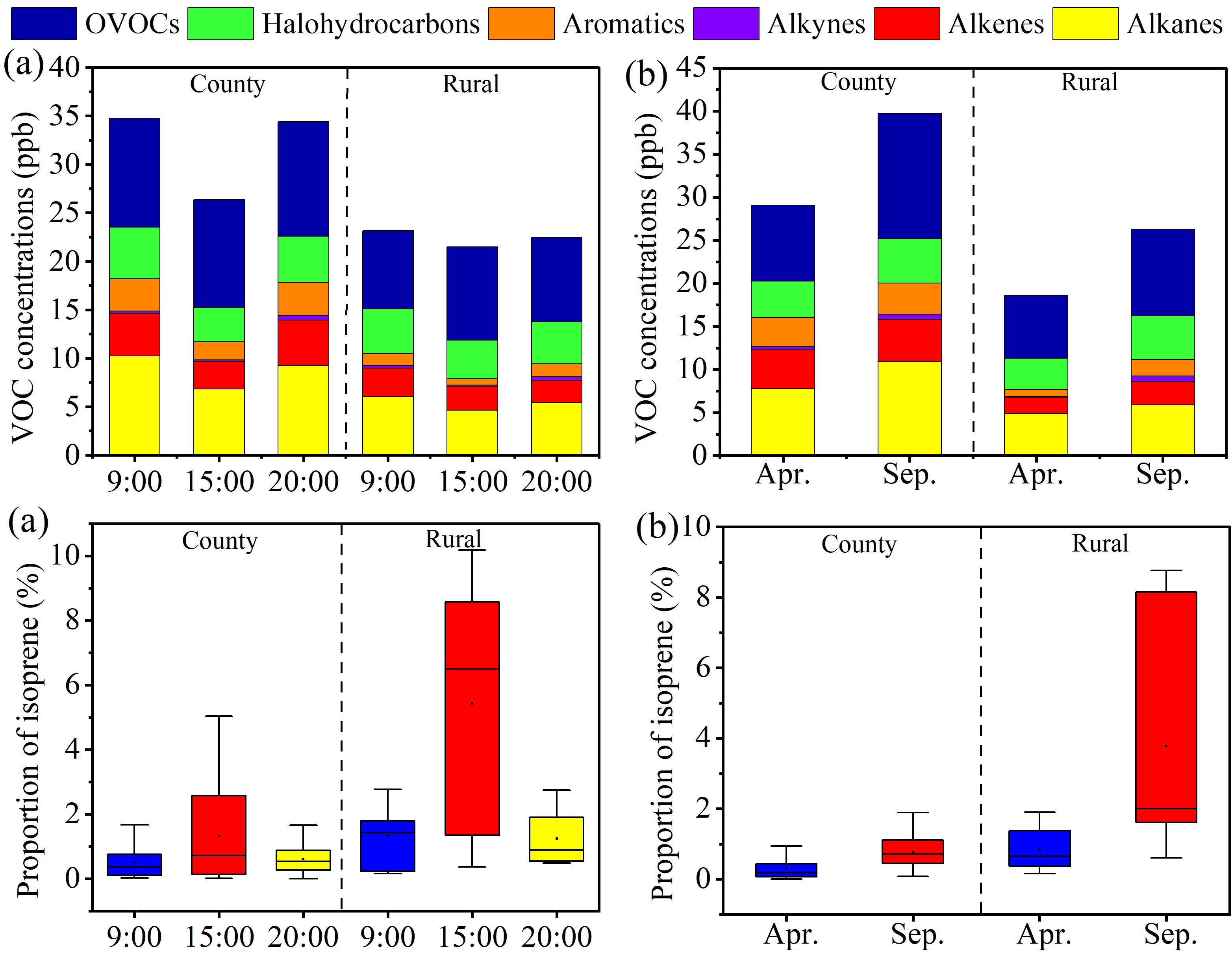
    Seasonal variations and sources of ambient volatile organic compounds (VOCs) were conducted at the county and rural sites in a mountain area of southeastern China. The results showed that the pattern of VOC concentrations was dominated by oxygenated VOCs (37.6%) and alkanes (25.8%), followed by halocarbons (16.8%), alkenes (11.9%), aromatics (6.87%), and alkynes (1.04%). Based on the OH radical loss rate (LOH) and ozone formation potential (OFP) analysis, alkenes had the highest chemical activity, especially the contribution of isoprene in rural areas. Aromatics contributed the most to secondary organic aerosols (SOA) formation in both county and rural areas. Source apportionment of VOCs were quantified by the positive matrix factorization (PMF) model, including industrial emissions and combustion burning (30.1% and 43.3% in the county and rural areas, respectively) and vehicle exhausts (30.3% and 10.8%), followed by solvent usage (17.1% and 5.2%), liquid petroleum gas (LPG) usage and fuel evaporation (14.2% and 10.0%), and biogenic source (8.3% and 30.6%). The backward air trajectories showed that air mass in spring was mainly originated from the intercity transmission, while the air clusters in autumn came from the northern areas through long-range transport. The study was helpful to understand the pollution characteristics in the mountainous area and provides a scientific basis for local O3 and PM2.5 pollution control.
    Key words:VOCs, Pollution characteristics, Source apportionment, Ozone formation potential, PMF model

    Volume:22

    Page:

    Journal:AEROSOL AND AIR QUALITY RESEARCH

    About Us

    • Brief Introduction
    • Address from the Director
    • Directors
    • Organization
    • IUE in Media

    Scientists

    • Academicians
    • Professors
    • Associate Professors

    Research

    • Research Divisions
    • Research Progress

    Education

    • Admission
    • Study at IUE
    • Scholarships

    INT'L Cooperation

    • INT'L Cooperation News
    • Partnership

    Papers

    Join Us

    • Job Opportunities
    • PIFI
    Copyright © Institute of Urban Environment,Chinese Academy of Sciences. All Rights Reserved.
    1799 Jimei Road, Xiamen 361021 China.+86-592-6190973.