


• Home
  • About Us
    • Brief Introduction
    • Address from the Director
    • Directors
    • Organization
    • IUE in Media
  • Scientists
    • Academicians
    • Professors
    • Associate Professors
  • Research
    • Research Divisions
    • Research Progress
  • Education
    • Admission
    • Study at IUE
    • Scholarships
  • INT'L Cooperation
    • INT'L Cooperation News
    • Partnership
  • Papers
  • Join Us
    • Job Opportunities
    • PIFI
      • What's PIFI
Contact Us   |   Sitemap   |   CAS   |   中文
  • Home
  • About Us
    • Brief Introduction
    • Address from the Director
    • Directors
    • Organization
    • IUE in Media
  • Scientists
    • Academicians
    • Professors
    • Associate Professors
  • Research
    • Research Divisions
    • Research Progress
  • Education
    • Admission
    • Study at IUE
    • Scholarships
  • INT'L Cooperation
    • INT'L Cooperation News
    • Partnership
  • Papers
  • Join Us
    • Job Opportunities
    • PIFI

Papers

  • HomePapers
  • Papers
    Influence of tree coverage and micro-topography on the thermal environment within and beyond a green space
    WU Zhifeng, WANG Man, REN Yin*

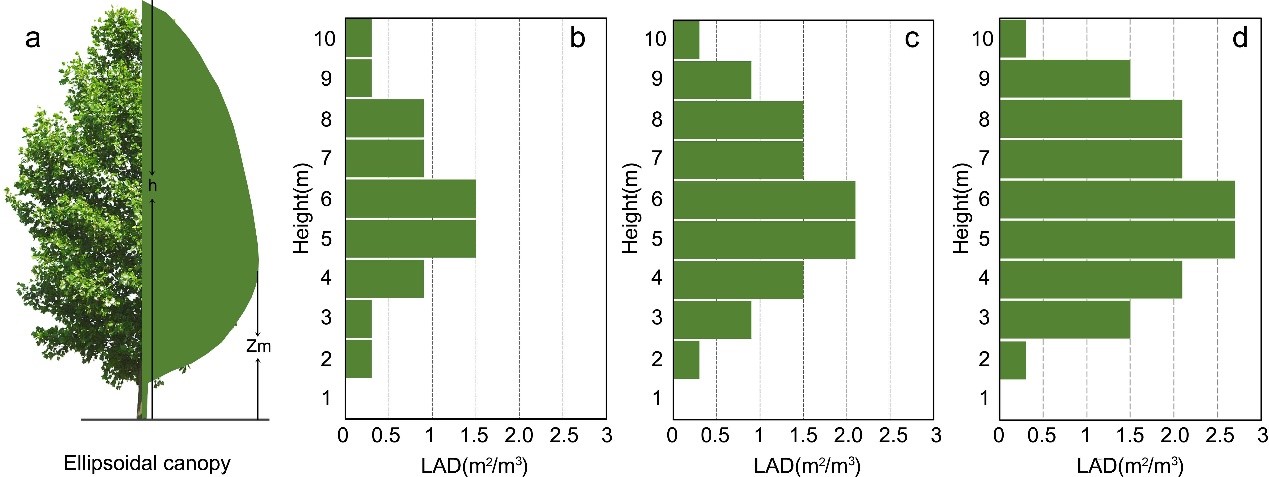
    The tree coverage of a green space strongly influences its cooling effects; however, knowledge about how the cooling capacity extends beyond a given green space remains limited, along with how modifications to micro-topography affect local thermal environments. Here, we aimed to clarify the cooling effects within and beyond a green space by systematically evaluating differing tree coverage and micro-topographic conditions. Specifically, idealized scenarios were designed and simulated using the micro-climate model ENVI-met. We found that both canopy size and tree number clearly influenced thermal environment conditions within and outside a green space during the daytime. The cooling capacity of the green space during the daytime was linearly correlated with the total leaf area of trees. We also found that modifications to micro-topography had stronger cooling effects on both the green space and adjacent open space in contrast to flat terrain scenarios. Increasing the connectivity of impervious spaces and green areas, along with appropriate micro-topographic modifications, could prevent surrounding impervious surfaces from becoming micro-scale heat islands during the daytime; thus, ameliorating heat stress conditions. The results of this research provide a baseline for climate-adaptive designs and planning of thermally comfortable urban landscapes in the future.
    Key words:Leaf area; Micro-climate modeling; Micro-topography; Thermal environment; Tree coverage; Urban planning

    Volume:316

    Page:108846

    Journal:AGRICULTURAL AND FOREST METEOROLOGY

    http://dx.doi.org/10.1016/j.agrformet.2022.108846

    About Us

    • Brief Introduction
    • Address from the Director
    • Directors
    • Organization
    • IUE in Media

    Scientists

    • Academicians
    • Professors
    • Associate Professors

    Research

    • Research Divisions
    • Research Progress

    Education

    • Admission
    • Study at IUE
    • Scholarships

    INT'L Cooperation

    • INT'L Cooperation News
    • Partnership

    Papers

    Join Us

    • Job Opportunities
    • PIFI
    Copyright © Institute of Urban Environment,Chinese Academy of Sciences. All Rights Reserved.
    1799 Jimei Road, Xiamen 361021 China.+86-592-6190973.