


• Home
  • About Us
    • Brief Introduction
    • Address from the Director
    • Directors
    • Organization
    • IUE in Media
  • Scientists
    • Academicians
    • Professors
    • Associate Professors
  • Research
    • Research Divisions
    • Research Progress
  • Education
    • Admission
    • Study at IUE
    • Scholarships
  • INT'L Cooperation
    • INT'L Cooperation News
    • Partnership
  • Papers
  • Join Us
    • Job Opportunities
    • PIFI
      • What's PIFI
Contact Us   |   Sitemap   |   CAS   |   中文
  • Home
  • About Us
    • Brief Introduction
    • Address from the Director
    • Directors
    • Organization
    • IUE in Media
  • Scientists
    • Academicians
    • Professors
    • Associate Professors
  • Research
    • Research Divisions
    • Research Progress
  • Education
    • Admission
    • Study at IUE
    • Scholarships
  • INT'L Cooperation
    • INT'L Cooperation News
    • Partnership
  • Papers
  • Join Us
    • Job Opportunities
    • PIFI

Papers

  • HomePapers
  • Papers
    Improving Plot-Level Model of Forest Biomass: A Combined Approach Using Machine Learning with Spatial Statistics
    DAI Shaoqing,ZHENG Xiaoman,GAO Lei,XU Chengdong, ZUO Shudi, CHEN Qi,WEI Xiaohua,REN Yin*

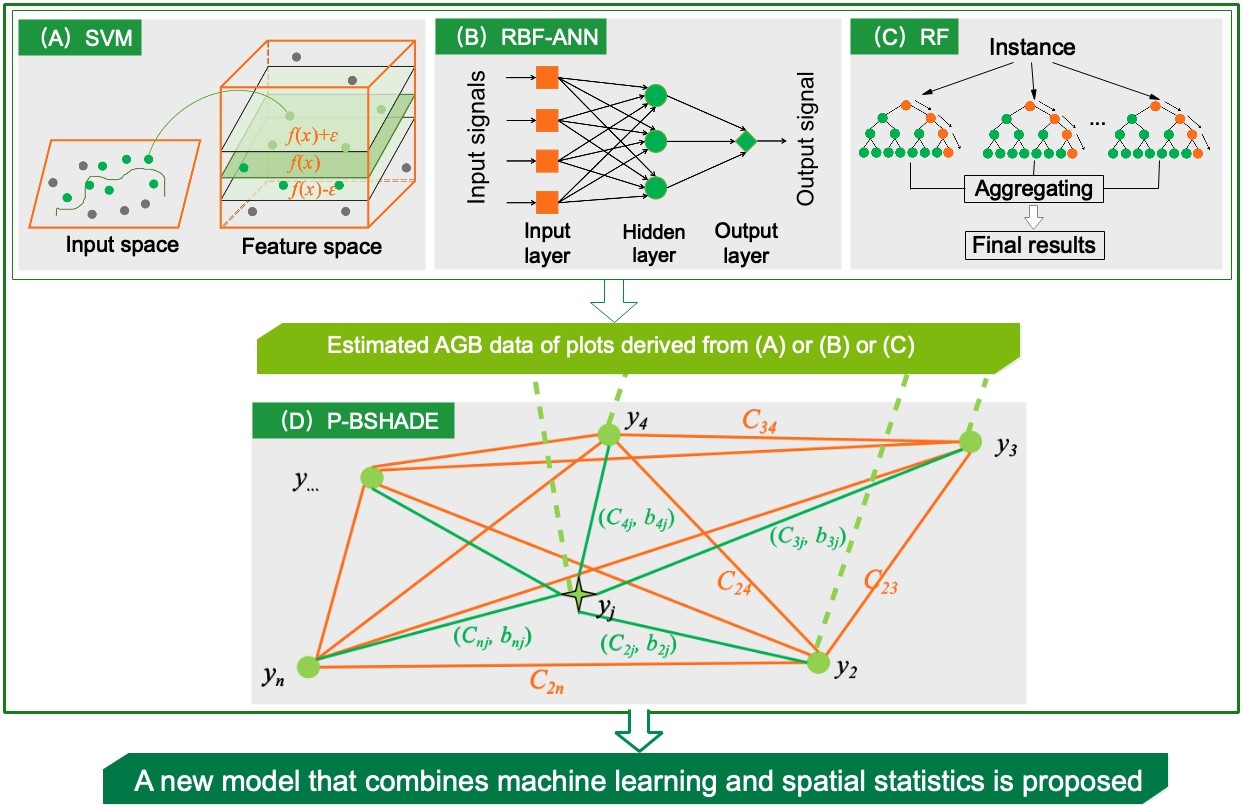
    Estimating the aboveground biomass (AGB) at the plot level plays a major role in connecting accurate single-tree AGB measurements to relatively difficult regional AGB estimates. However, AGB estimates at the plot level suffer from many uncertainties. The goal of this study is to determine whether combining machine learning with spatial statistics reduces the uncertainty of plot-level AGB estimates. To illustrate this issue, this study evaluates and compares the performance of different models for estimating plot-level forest AGB. These models include three different machine learning models [support vector machine (SVM), random forest (RF), and a radial basis function artificial neural network (RBF-ANN)], one spatial statistic model (P-BSHADE), and three combinations thereof (SVM & P-BSHADE, RF & P-BSHADE, and RBF-ANN & P-BSHADE). The results show that the root mean square error, mean absolute error, and mean relative error of all combined models are substantially smaller than those of any individual model, with the RF & P-BSHADE combined method generating the smallest values. These results indicate that a combined approach using machine learning with spatial statistics, especially the RF & P-BSHADE model, improves the accuracy of plot-level AGB models. These research results contribute to the development of accurate large-forested-landscape AGB maps.
    Key words:forest aboveground biomass; plot-level model; machine learning; spatial statistical model; model combination

    Volume:12

    Page:1663

    Journal:FORESTS

    https://doi.org/10.3390/ f12121663

    About Us

    • Brief Introduction
    • Address from the Director
    • Directors
    • Organization
    • IUE in Media

    Scientists

    • Academicians
    • Professors
    • Associate Professors

    Research

    • Research Divisions
    • Research Progress

    Education

    • Admission
    • Study at IUE
    • Scholarships

    INT'L Cooperation

    • INT'L Cooperation News
    • Partnership

    Papers

    Join Us

    • Job Opportunities
    • PIFI
    Copyright © Institute of Urban Environment,Chinese Academy of Sciences. All Rights Reserved.
    1799 Jimei Road, Xiamen 361021 China.+86-592-6190973.