


• Home
  • About Us
    • Brief Introduction
    • Address from the Director
    • Directors
    • Organization
    • IUE in Media
  • Scientists
    • Academicians
    • Professors
    • Associate Professors
  • Research
    • Research Divisions
    • Research Progress
  • Education
    • Admission
    • Study at IUE
    • Scholarships
  • INT'L Cooperation
    • INT'L Cooperation News
    • Partnership
  • Papers
  • Join Us
    • Job Opportunities
    • PIFI
      • What's PIFI
Contact Us   |   Sitemap   |   CAS   |   中文
  • Home
  • About Us
    • Brief Introduction
    • Address from the Director
    • Directors
    • Organization
    • IUE in Media
  • Scientists
    • Academicians
    • Professors
    • Associate Professors
  • Research
    • Research Divisions
    • Research Progress
  • Education
    • Admission
    • Study at IUE
    • Scholarships
  • INT'L Cooperation
    • INT'L Cooperation News
    • Partnership
  • Papers
  • Join Us
    • Job Opportunities
    • PIFI

Papers

  • HomePapers
  • Papers
    Rational design of pore structures for carbon aerogels to significantly increase adsorption of tetracycline from water using batch and fixed-bed operation
    Wen-Cui Xu, Lu-Bin Zhong,* Zai-Dong Shao, Shuai Dou, Liang Yu, Xuan Cheng and Yu-Ming Zheng*

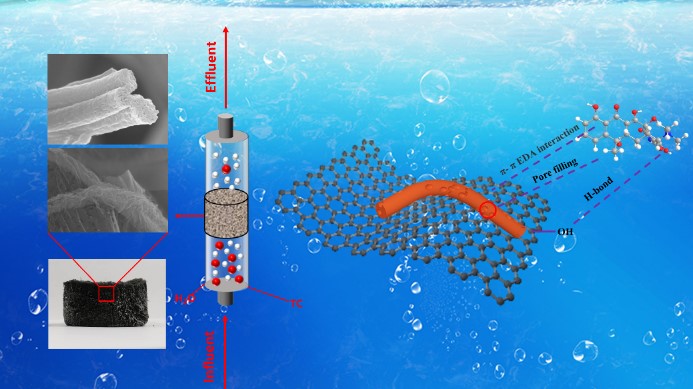
    Three-dimensional (3D) adsorption materials have attracted ever-increasing interest as a cost-effective tool to remove antibiotics from water. However, how to effectively enhance the adsorption capacity of the adsorbents is still a great challenge. In this study, a novel method for fabricating 3D porous carbon nanofiber/graphene oxide composite aerogels (PCNF/GOAs) with an adjustable pore structure was developed for antibiotic removal from water using electrospinning-liquid assisted collection technology. By adding poly(methyl methacrylate) (PMMA) as a pore-forming agent, the volume of pores corresponding to the tetracycline (TC) size (0.8–2 nm) increased twelve-fold, and the adsorption capacity increased nine-fold. To evaluate the feasibility of PCNF/GOAs as a potential adsorbent for antibiotic removal, batch and fixed-bed experiments were conducted. The results showed that PCNF/GOAs effectively removed TC from water over a wide pH range (4–10), and the maximum adsorption capacity was more than 900 mg g-1 at pH 7. The experimental data for the adsorption of TC onto PCNF/GOAs better fitted the pseudo-second-order kinetic and Temkin models. Due to its self-supporting characteristic, 3D PCNF/GOAs generated lower inlet pressure compared to traditional particle adsorbents in fixed-bed column adsorption. π–π electro-donor–acceptor (EDA) interaction, pore filling and hydrogen bonding are the main possible mechanisms for the adsorption of TC on PCNF/GOAs.
    Key words:Pore structure; Pore-forming agent, Tetracycline, Adsorption, carbon aerogels

    Volume:8

    Page:3250-3261

    Journal:ENVIRONMENTAL SCIENCE-NANO

    DOI https://doi.org/10.1039/D1EN00459J

    About Us

    • Brief Introduction
    • Address from the Director
    • Directors
    • Organization
    • IUE in Media

    Scientists

    • Academicians
    • Professors
    • Associate Professors

    Research

    • Research Divisions
    • Research Progress

    Education

    • Admission
    • Study at IUE
    • Scholarships

    INT'L Cooperation

    • INT'L Cooperation News
    • Partnership

    Papers

    Join Us

    • Job Opportunities
    • PIFI
    Copyright © Institute of Urban Environment,Chinese Academy of Sciences. All Rights Reserved.
    1799 Jimei Road, Xiamen 361021 China.+86-592-6190973.