


• Home
  • About Us
    • Brief Introduction
    • Address from the Director
    • Directors
    • Organization
    • IUE in Media
  • Scientists
    • Academicians
    • Professors
    • Associate Professors
  • Research
    • Research Divisions
    • Research Progress
  • Education
    • Admission
    • Study at IUE
    • Scholarships
  • INT'L Cooperation
    • INT'L Cooperation News
    • Partnership
  • Papers
  • Join Us
    • Job Opportunities
    • PIFI
      • What's PIFI
Contact Us   |   Sitemap   |   CAS   |   中文
  • Home
  • About Us
    • Brief Introduction
    • Address from the Director
    • Directors
    • Organization
    • IUE in Media
  • Scientists
    • Academicians
    • Professors
    • Associate Professors
  • Research
    • Research Divisions
    • Research Progress
  • Education
    • Admission
    • Study at IUE
    • Scholarships
  • INT'L Cooperation
    • INT'L Cooperation News
    • Partnership
  • Papers
  • Join Us
    • Job Opportunities
    • PIFI

Papers

  • HomePapers
  • Papers
    Moderate sewage sludge biochar application on alkaline soil for corn growth: a field study
    Shengyu Xie,Guangwei Yu*,Ruqing Jiang,Jianli Ma,Xiaofu Shang,Gang Wang,Yin Wang,Yongan Yang & Chunxing Li

    In view of the risks induced by the inhibitory effects of applying impracticably large amounts of sewage sludge biochar (SSB) to the alkaline soil, this field study investigated the influence of moderate biochar amendments (0, 1500, 4500, and 9000 kg/hm2) on corn growth, alkaline soil properties, and the uptake of potentially toxic elements (PTEs). The results showed that applying more SSB would decrease the ammonium nitrogen concentration and increase the available phosphorus and potassium concentrations, which inhibited corn plant growth because of high background nutrient levels of the alkaline soil. When the alkaline soil was amended with 1500 kg/hm2 SSB, the dry weight of 100 niblets increased from 32.11 g in the control to 35.07 g. There was no significant variation in the total concentration of PTEs in the soil. The concentrations of Mn, Ni, Cu, and Zn in niblets decreased from 5.54, 0.83, 2.26, and 27.15 mg/kg in the control to 4.47, 0.62, 1.30, and 23.45 mg/kg, respectively. Accordingly, the health risk from corn consumption was significantly reduced. Furthermore, the combination of SSB and fertilizer improved corn growth and reduced the risk of consumption of PTEs. Therefore, considering the increase in corn fruit yield and the decrease in consumption risk, applying 1500 kg/hm2 of biochar to alkaline soils is a realistically achievable rate, which can broaden the utilization of SSB for remediation of different types of soil.
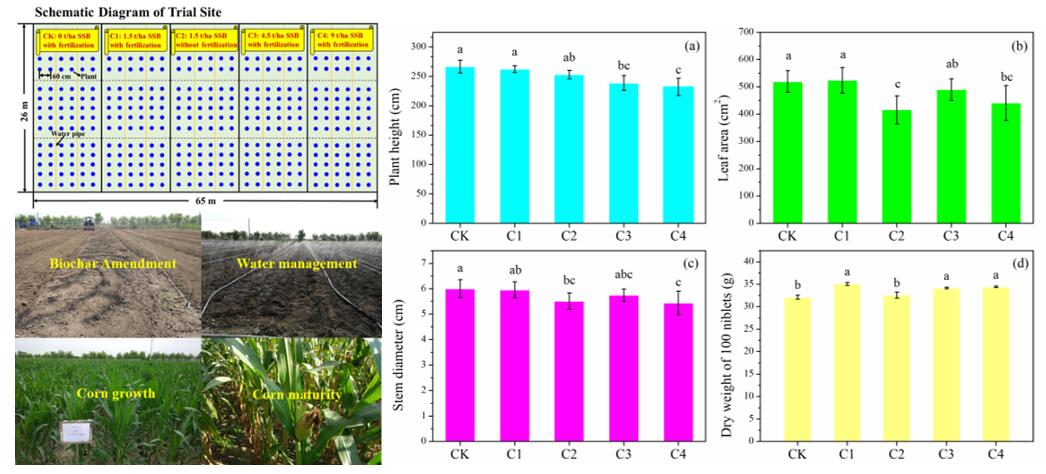
     

    Schematic diagram and photographs of the field plantings

    Key words:Sewage sludge biochar;Alkaline soil;Corn growth;Soil property;Potentially toxic elements;Soil remediation

    Volume:3

    Page:135–147

    Journal:BIOCHAR

    https://link.springer.com/article/10.1007/s42773-021-00085-3

    About Us

    • Brief Introduction
    • Address from the Director
    • Directors
    • Organization
    • IUE in Media

    Scientists

    • Academicians
    • Professors
    • Associate Professors

    Research

    • Research Divisions
    • Research Progress

    Education

    • Admission
    • Study at IUE
    • Scholarships

    INT'L Cooperation

    • INT'L Cooperation News
    • Partnership

    Papers

    Join Us

    • Job Opportunities
    • PIFI
    Copyright © Institute of Urban Environment,Chinese Academy of Sciences. All Rights Reserved.
    1799 Jimei Road, Xiamen 361021 China.+86-592-6190973.