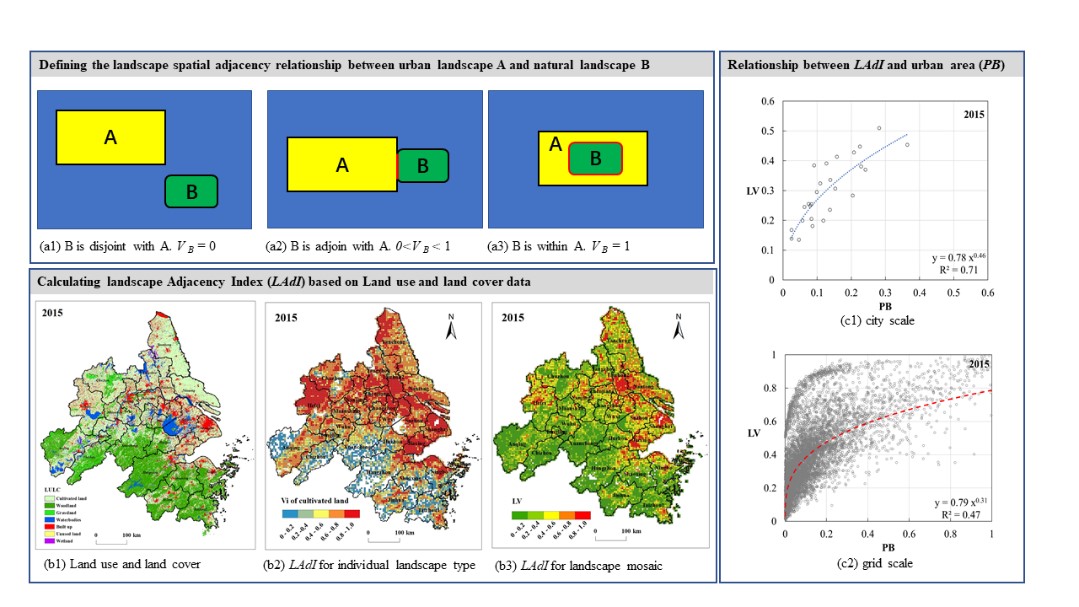
Urban spatial expansion poses a threat to regional ecosystems and biodiversity directly through altering the size, shape, and interconnectivity of natural landscapes. Monitoring urban spatial expansion using traditional area-based metrics from remote sensing provides a feasible way to quantify this regional ecological stress. However, variation in landscape-adjacency relationships (i.e., the adjacency between individual landscape classes) caused by urban expansion is often overlooked. In this study, a novel edge-based index (landscape-adjacency index, LAdI) was proposed based on the spatial-adjacency relationship between landscape patches to measure the regional ecological stress of urban expansion on natural landscapes. Taking the entire Yangtze River Delta Urban Agglomerations (YRD) as a study area, we applied the LAdI for individual landscape classes (Vi) and landscape level (LV) to quantitatively assess change over time in the ecological stress of YRD from 1990 to 2015 at two spatial scales: municipal scale and 5 km-grid scale. The results showed that the vulnerable zones (LV ≥ 0.6) were mainly distributed in the north of the YRD, and cultivated land was the most vulnerable natural landscape (Vi ≥ 0.6) at the 5 km-grid scale. The most vulnerable landscape at the municipal scale was cultivated land in 19 of 26 cities in each period, and that in the remaining 7 cities varied at distinct urbanization stages. We used scatter diagrams and Pearson correlation analysis to compare the edge-based LAdI with an area-based index (percent of built-up area, PB) and found that: LV and PB had a significant positive correlation at both the municipal scale and 5 km-grid scale. But there were multiple LVs with different values corresponding to one PB with the same value at the 5 km-grid scale. Both indexes could represent the degree of urban expansion; however, the edge-based metric better quantified ecological stress under different urban-sprawl patterns sharing the same percent of built-up area. As changes in land use affect both the size and edge effect among landscape patches, the area-based PB and the edge-based LAdI should be applied together when assessing the ecological stress caused by urbanization.