


• Home
  • About Us
    • Brief Introduction
    • Address from the Director
    • Directors
    • Organization
    • IUE in Media
  • Scientists
    • Academicians
    • Professors
    • Associate Professors
  • Research
    • Research Divisions
    • Research Progress
  • Education
    • Admission
    • Study at IUE
    • Scholarships
  • INT'L Cooperation
    • INT'L Cooperation News
    • Partnership
  • Papers
  • Join Us
    • Job Opportunities
    • PIFI
      • What's PIFI
Contact Us   |   Sitemap   |   CAS   |   中文
  • Home
  • About Us
    • Brief Introduction
    • Address from the Director
    • Directors
    • Organization
    • IUE in Media
  • Scientists
    • Academicians
    • Professors
    • Associate Professors
  • Research
    • Research Divisions
    • Research Progress
  • Education
    • Admission
    • Study at IUE
    • Scholarships
  • INT'L Cooperation
    • INT'L Cooperation News
    • Partnership
  • Papers
  • Join Us
    • Job Opportunities
    • PIFI

Papers

  • HomePapers
  • Papers
    Molecular-level variation of dissolved organic matter and microbial structure of produced water during its early storage in Fuling shale gas field, China
    Ji, YF (Ji, Yufei); Zhang, ZJ* (Zhang, Zhaoji); Zhuang, YL (Zhuang, Yiling); Liao, RG (Liao, Rugang); Zhou, ZJ (Zhou, Zejun); Chen, SH* (Chen, Shaohua)

    Shale gas-produced water (PW), the waste fluid generated during gas production, contains a large number of organic contaminants and high salinity matrix. Previous studies generally focused on the end-of-pipe treatment of the PW and ignored the early collection process. In this study, the transformation of the molecular composition and microbial community structure of the PW in the transportation and storage process (i.e., from the gas-liquid separator to the storage tank) were investigated. As the PW was transported from the gas-liquid separator to the portable storage tank, the dissolved organic matter (DOM) showed greater saturation, less oxidation, and lower polarity. DOMs with high O/C and low H/C ratios (numbers of oxygen and hydrogen divided by numbers of carbon) were eliminated, which may be due to precipitation or adsorption by the solids suspended in the PW. The values of double-bond equivalent (DBE), DBE/C (DBE divided by the number of carbon), and aromatic index (AI) decreased, likely because of the microbial degradation of aromatic compounds. The PW in the gas-liquid separator presented a lower biodiversity than that in the storage tank. The microbial community in the storage tank showed the coexistence of anaerobes and aerobes. Genera related to biocorrosion and souring were detected in the two facilities, thus indicating the necessity of more efficient anticorrosion strategies. This study helps to enhance the understanding of the environmental behavior of PW during shale gas collection and provides a scientific reference for the design and formulation of efficient transportation and storage strategies to prevent and control the environmental risk of shale gas-derived PW.
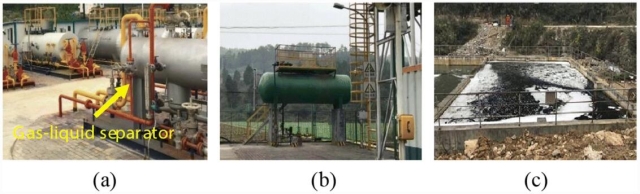
    Surficial infrastructure of a typical gas-gathering station for the temporary storage of produced water. a Gas–liquid separator and b storage tank set in the station; c open wastewater impoundment outside the station

    Key words:Produced water; Shale gas; Dissolved organic matter; Microbial community structure; Transportation and storage phrase

    Volume:

    Page:

    Journal:ENVIRONMENTAL SCIENCE AND POLLUTION RESEARCH

    https://link.springer.com/article/10.1007/s11356-021-13228-7

    About Us

    • Brief Introduction
    • Address from the Director
    • Directors
    • Organization
    • IUE in Media

    Scientists

    • Academicians
    • Professors
    • Associate Professors

    Research

    • Research Divisions
    • Research Progress

    Education

    • Admission
    • Study at IUE
    • Scholarships

    INT'L Cooperation

    • INT'L Cooperation News
    • Partnership

    Papers

    Join Us

    • Job Opportunities
    • PIFI
    Copyright © Institute of Urban Environment,Chinese Academy of Sciences. All Rights Reserved.
    1799 Jimei Road, Xiamen 361021 China.+86-592-6190973.