


• Home
  • About Us
    • Brief Introduction
    • Address from the Director
    • Directors
    • Organization
    • IUE in Media
  • Scientists
    • Academicians
    • Professors
    • Associate Professors
  • Research
    • Research Divisions
    • Research Progress
  • Education
    • Admission
    • Study at IUE
    • Scholarships
  • INT'L Cooperation
    • INT'L Cooperation News
    • Partnership
  • Papers
  • Join Us
    • Job Opportunities
    • PIFI
      • What's PIFI
Contact Us   |   Sitemap   |   CAS   |   中文
  • Home
  • About Us
    • Brief Introduction
    • Address from the Director
    • Directors
    • Organization
    • IUE in Media
  • Scientists
    • Academicians
    • Professors
    • Associate Professors
  • Research
    • Research Divisions
    • Research Progress
  • Education
    • Admission
    • Study at IUE
    • Scholarships
  • INT'L Cooperation
    • INT'L Cooperation News
    • Partnership
  • Papers
  • Join Us
    • Job Opportunities
    • PIFI

Papers

  • HomePapers
  • Papers
    Analysis of microbial contamination of household water purifiers
    LIN Wenfang; YE Chengsong; GUO Lizheng; HU Dong & YU Xin *

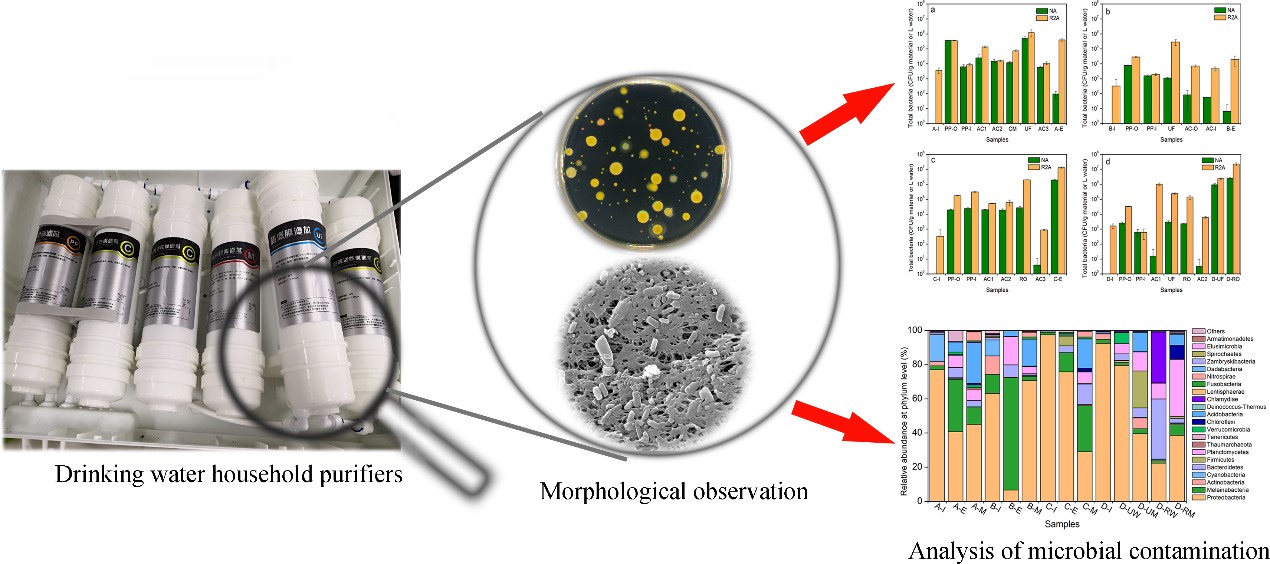
    Household water purifiers are increasingly used to treat drinking water at the household level, but their influence on the microbiological safety of drinking water has rarely been assessed. In this study, representative purifiers, based on different filtering processes, were analyzed for their impact on effluent water quality. The results showed that purifiers reduced chemical qualities such as turbidity and free chlorine. However, a high level of bacteria (102–106 CFU/g) was detected at each stage of filtration using a traditional culture-dependent method, whereas quantitative PCR with propidium monoazide (PMA) treatment showed 106–108 copies/L of total viable bacteria in effluent water, indicating elevated microbial contaminants after purifiers. In addition, high-throughput sequencing revealed a diverse microbial community in effluents and membranes. Proteobacteria (22.06–97.42%) was the dominant phylum found in all samples, except for purifier B, in which Melainabacteria was most abundant (65.79%). For waterborne pathogens, Escherichia coli (100–106 copies/g) and Pseudomonas aeruginosa (100–105 copies/g) were frequently detected by qPCR. Sequencing also demonstrated the presence of E. coli (0–6.26%), Mycobacterium mucogenicum (0.01–3.46%), and P. aeruginosa (0–0.16%) in purifiers. These finding suggest that water from commonly used household purifiers still impose microbial risks to human health.
    Key words:

    Volume:104

    Page:pages4533–4545

    Journal:Applied Microbiology and Biotechnology

    https://link.springer.com/article/10.1007/s00253-020-10510-5

    About Us

    • Brief Introduction
    • Address from the Director
    • Directors
    • Organization
    • IUE in Media

    Scientists

    • Academicians
    • Professors
    • Associate Professors

    Research

    • Research Divisions
    • Research Progress

    Education

    • Admission
    • Study at IUE
    • Scholarships

    INT'L Cooperation

    • INT'L Cooperation News
    • Partnership

    Papers

    Join Us

    • Job Opportunities
    • PIFI
    Copyright © Institute of Urban Environment,Chinese Academy of Sciences. All Rights Reserved.
    1799 Jimei Road, Xiamen 361021 China.+86-592-6190973.