


• Home
  • About Us
    • Brief Introduction
    • Address from the Director
    • Directors
    • Organization
    • IUE in Media
  • Scientists
    • Academicians
    • Professors
    • Associate Professors
  • Research
    • Research Divisions
    • Research Progress
  • Education
    • Admission
    • Study at IUE
    • Scholarships
  • INT'L Cooperation
    • INT'L Cooperation News
    • Partnership
  • Papers
  • Join Us
    • Job Opportunities
    • PIFI
      • What's PIFI
Contact Us   |   Sitemap   |   CAS   |   中文
  • Home
  • About Us
    • Brief Introduction
    • Address from the Director
    • Directors
    • Organization
    • IUE in Media
  • Scientists
    • Academicians
    • Professors
    • Associate Professors
  • Research
    • Research Divisions
    • Research Progress
  • Education
    • Admission
    • Study at IUE
    • Scholarships
  • INT'L Cooperation
    • INT'L Cooperation News
    • Partnership
  • Papers
  • Join Us
    • Job Opportunities
    • PIFI

Papers

  • HomePapers
  • Papers
    Responses of zooplankton body size and community trophic structure to temperature change in a subtropical reservoir
    Gao, XF (Gao, Xiaofei); Chen, HH (Chen, Huihuang); Govaert, L (Govaert, Lynn), Wang, WP (Wang, Wenping); Yang, J* (Yang, Jun)

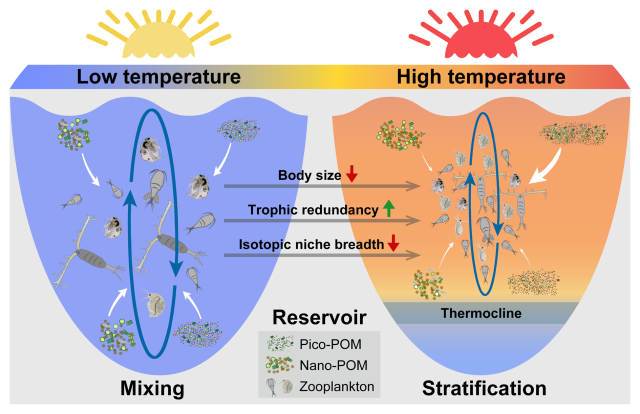
    Understanding the effects of global warming on trait variation and trophic structure is a crucial challenge in the 21st century. However, there is a lack of general patterns that can be used to predict trait variation and community trophic structure under the ongoing environmental change. We investigated the responses of body size and community trophic structure of zooplankton to climate related factors (e.g., temperature). Isotopic niche breadth was applied to investigate the community trophic structure across a 1‐year study from a subtropical reservoir (Tingxi Reservoir) in southeastern China. Body size and community isotopic niche breadth of zooplankton were larger during water mixing than stratification periods and correlated significantly with water temperature change along the time series. The contributions of intra‐ and intertaxonomic components to body size and community trophic structure variation showed significant relationships with the temperature change going from the mixing to stratification periods. Water temperature imposed direct effect on body size, while direct and indirect effect on the community trophic structure of zooplankton occurred through trophic redundancy along time series. Water temperature and community properties (e.g., body size, trophic redundancy, or trophic interaction) showed complex interactions and integrated to influence community trophic structure of zooplankton. Our results can expand the knowledge of how elevated temperature will alter individual trait and community trophic structure under future climate change.
    Key words:Plankton; Subtropical reservoir; Community Ecology; Trophic Structure; Trait Variation; Temperature

    Volume:9

    Page:12544-12555

    Journal:ECOLOGY AND EVOLUTION

    https://onlinelibrary_wiley.xilesou.top/doi/abs/10.1002/ece3.5718

    About Us

    • Brief Introduction
    • Address from the Director
    • Directors
    • Organization
    • IUE in Media

    Scientists

    • Academicians
    • Professors
    • Associate Professors

    Research

    • Research Divisions
    • Research Progress

    Education

    • Admission
    • Study at IUE
    • Scholarships

    INT'L Cooperation

    • INT'L Cooperation News
    • Partnership

    Papers

    Join Us

    • Job Opportunities
    • PIFI
    Copyright © Institute of Urban Environment,Chinese Academy of Sciences. All Rights Reserved.
    1799 Jimei Road, Xiamen 361021 China.+86-592-6190973.