


• Home
  • About Us
    • Brief Introduction
    • Address from the Director
    • Directors
    • Organization
    • IUE in Media
  • Scientists
    • Academicians
    • Professors
    • Associate Professors
  • Research
    • Research Divisions
    • Research Progress
  • Education
    • Admission
    • Study at IUE
    • Scholarships
  • INT'L Cooperation
    • INT'L Cooperation News
    • Partnership
  • Papers
  • Join Us
    • Job Opportunities
    • PIFI
      • What's PIFI
Contact Us   |   Sitemap   |   CAS   |   中文
  • Home
  • About Us
    • Brief Introduction
    • Address from the Director
    • Directors
    • Organization
    • IUE in Media
  • Scientists
    • Academicians
    • Professors
    • Associate Professors
  • Research
    • Research Divisions
    • Research Progress
  • Education
    • Admission
    • Study at IUE
    • Scholarships
  • INT'L Cooperation
    • INT'L Cooperation News
    • Partnership
  • Papers
  • Join Us
    • Job Opportunities
    • PIFI

Papers

  • HomePapers
  • Papers
    Response of the eukaryotic plankton community to the cyanobacterial biomass cycle over 6 years in two subtropical reservoirs
    Liu, LM (Liu, Lemian); Chen, HH (Chen, Huihuang); Liu, M (Liu, Min); Yang, JR (Yang, Jun R.); Xiao, P (Xiao, Peng); Wilkinson, DM (Wilkinson, David M.); Yang, J* (Yang, Jun)

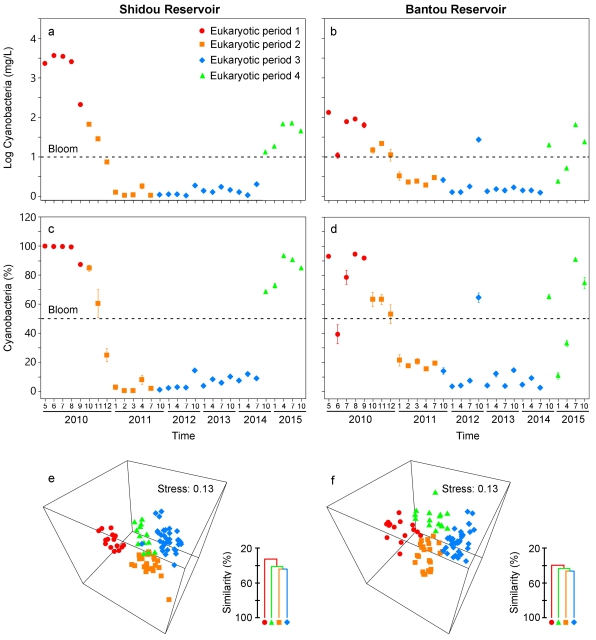
    Although it is widely recognized that cyanobacterial blooms have substantial influence on the plankton community in general, their correlations with the whole community of eukaryotic plankton at longer time scales remain largely unknown. Here, we investigated the temporal dynamics of eukaryotic plankton communities in two subtropical reservoirs over a 6-year period (2010-2015) following one cyanobacterial biomass cycle-the cyanobacterial bloom (middle 2010), cyanobacteria decrease (late 2010-early 2011), non-bloom (2011-2014), cyanobacteria increase, and second bloom (late 2014-2015). The eukaryotic community succession that strongly correlated with this cyanobacterial biomass cycle was divided into four periods, and each period had distinct characteristics in cyanobacterial biomass and environments in both reservoirs. Integrated co-occurrence networks of eukaryotic plankton based on the whole study period revealed that the cyanobacterial biomass had remarkably high network centralities, and the eukaryotic OTUs that had stronger correlations with the cyanobacterial biomass exhibited higher centralities. The integrated networks were also modularly responded to different eukaryotic succession periods, and therefore correlated with the cyanobacterial biomass cycle. Moreover, sub-networks based on the different eukaryotic succession periods indicated that the eukaryotic co-occurrence patterns were not constant but varied largely associating with the cyanobacterial biomass. Based on these long-term observations, our results reveal that the cyanobacterial biomass cycle created distinct niches between persistent bloom, non-bloom, decrease and increase of cyanobacteria, and therefore associated with distinct eukaryotic plankton patterns. Our results have important implications for understanding how complex aquatic plankton communities respond to cyanobacterial blooms under the changing environments.
     

    Key words:Plankton; Microeukaryotic community; Subtropical reservoir; Cyanobacterial bloom; Co-occurrence network

    Volume:13

    Page:2196-2208

    Journal:ISME JOURNAL

    https://www.nature.com/articles/s41396-019-0417-9

    About Us

    • Brief Introduction
    • Address from the Director
    • Directors
    • Organization
    • IUE in Media

    Scientists

    • Academicians
    • Professors
    • Associate Professors

    Research

    • Research Divisions
    • Research Progress

    Education

    • Admission
    • Study at IUE
    • Scholarships

    INT'L Cooperation

    • INT'L Cooperation News
    • Partnership

    Papers

    Join Us

    • Job Opportunities
    • PIFI
    Copyright © Institute of Urban Environment,Chinese Academy of Sciences. All Rights Reserved.
    1799 Jimei Road, Xiamen 361021 China.+86-592-6190973.