


• Home
  • About Us
    • Brief Introduction
    • Address from the Director
    • Directors
    • Organization
    • IUE in Media
  • Scientists
    • Academicians
    • Professors
    • Associate Professors
  • Research
    • Research Divisions
    • Research Progress
  • Education
    • Admission
    • Study at IUE
    • Scholarships
  • INT'L Cooperation
    • INT'L Cooperation News
    • Partnership
  • Papers
  • Join Us
    • Job Opportunities
    • PIFI
      • What's PIFI
Contact Us   |   Sitemap   |   CAS   |   中文
  • Home
  • About Us
    • Brief Introduction
    • Address from the Director
    • Directors
    • Organization
    • IUE in Media
  • Scientists
    • Academicians
    • Professors
    • Associate Professors
  • Research
    • Research Divisions
    • Research Progress
  • Education
    • Admission
    • Study at IUE
    • Scholarships
  • INT'L Cooperation
    • INT'L Cooperation News
    • Partnership
  • Papers
  • Join Us
    • Job Opportunities
    • PIFI

Papers

  • HomePapers
  • Papers
    Spatial Distribution and Potential Sources of Five Heavy Metals and One Metalloid in the Soils of Xiamen City, China
    Huang, S (Huang, Sha); Shao, GF (Shao, Guofan); Wang, LY (Wang, Luyan); Tang, LN* (Tang, Lina)

    In our study, we collected 146 surface soil samples in Xiamen City and measured the concentrations of five heavy metals (Cr, Cu, Pb, Ni, and Zn) and one metalloid (As). Multivariate statistics, geostatistics and Random Forest methods were applied to identify the potential sources and spatial variation of the six elements. The results revealed that As, Cr, and Ni originated mainly from industrial activities, and higher concentrations were found in developed areas. The amounts of Cu, Pb, and Zn in soils were mainly predetermined by soil parent material and agricultural activities. Besides, the atmospheric deposition rather than industrial activities substantially influenced the accumulation of Pb in the soils near the boundary between Tong’an and Quanzhou City, because there were few industries but many forests in this area. Because of the connections of the six elements with factor values of factor analysis, appropriate and accessible covariates could be used in co-kriging to increase the accuracies of interpolation of heavy metal and metalloid concentrations relative to that in ordinary kriging.
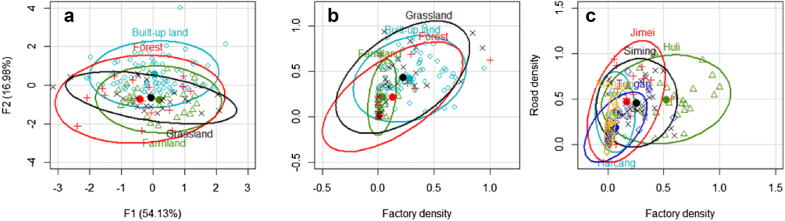
    The ordination plot of 146 samples from different land use types or different districts
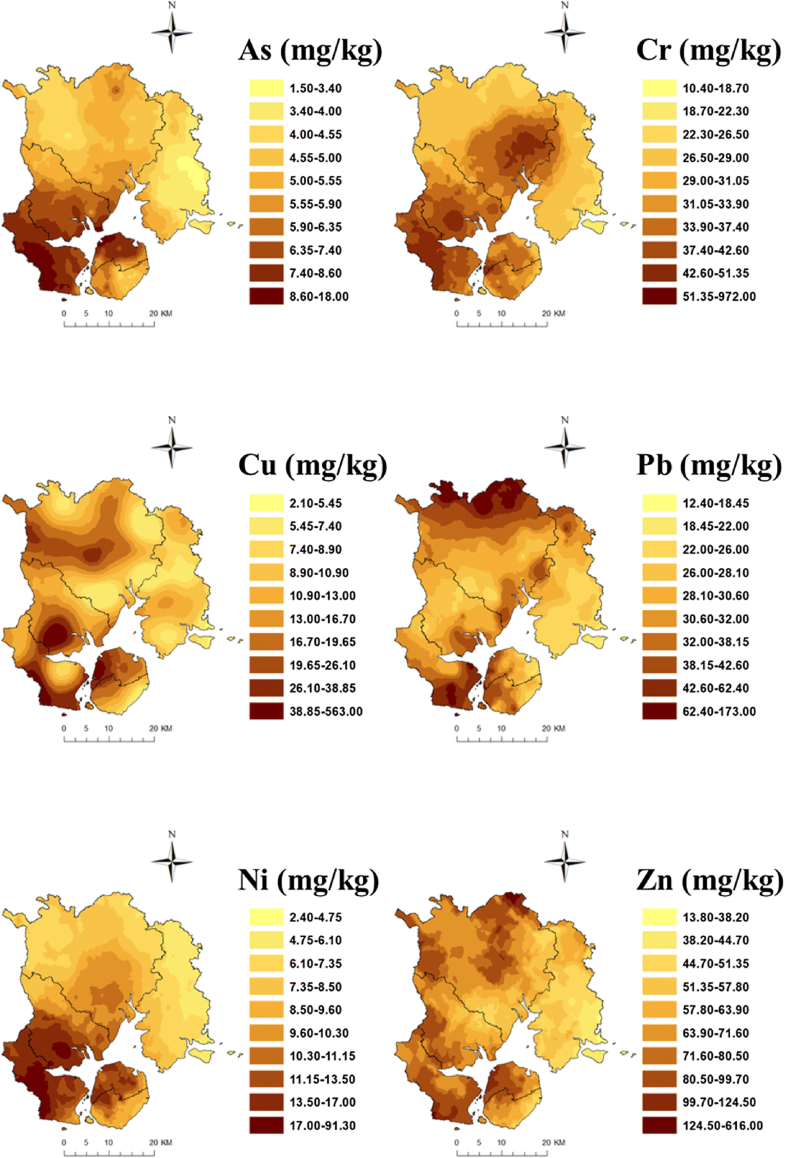
    Spatial distribution of soil heavy metal and metalloid concentrations in the soils of Xiamen City

    Key words:Soil heavy metal; Co-kriging; Source identification; Random Forest; Xiamen City

    Volume:103

    Page:308-315

    Journal:BULLETIN OF ENVIRONMENTAL CONTAMINATION AND TOXICOLOGY

    https://doi.org/10.1007/s00128-019-02639-5

    About Us

    • Brief Introduction
    • Address from the Director
    • Directors
    • Organization
    • IUE in Media

    Scientists

    • Academicians
    • Professors
    • Associate Professors

    Research

    • Research Divisions
    • Research Progress

    Education

    • Admission
    • Study at IUE
    • Scholarships

    INT'L Cooperation

    • INT'L Cooperation News
    • Partnership

    Papers

    Join Us

    • Job Opportunities
    • PIFI
    Copyright © Institute of Urban Environment,Chinese Academy of Sciences. All Rights Reserved.
    1799 Jimei Road, Xiamen 361021 China.+86-592-6190973.