


• Home
  • About Us
    • Brief Introduction
    • Address from the Director
    • Directors
    • Organization
    • IUE in Media
  • Scientists
    • Academicians
    • Professors
    • Associate Professors
  • Research
    • Research Divisions
    • Research Progress
  • Education
    • Admission
    • Study at IUE
    • Scholarships
  • INT'L Cooperation
    • INT'L Cooperation News
    • Partnership
  • Papers
  • Join Us
    • Job Opportunities
    • PIFI
      • What's PIFI
Contact Us   |   Sitemap   |   CAS   |   中文
  • Home
  • About Us
    • Brief Introduction
    • Address from the Director
    • Directors
    • Organization
    • IUE in Media
  • Scientists
    • Academicians
    • Professors
    • Associate Professors
  • Research
    • Research Divisions
    • Research Progress
  • Education
    • Admission
    • Study at IUE
    • Scholarships
  • INT'L Cooperation
    • INT'L Cooperation News
    • Partnership
  • Papers
  • Join Us
    • Job Opportunities
    • PIFI

Papers

  • HomePapers
  • Papers
    Subcellular distribution and tolerance of cadmium in Canna indica L.
    Xiaoxia Dong, Fan Yang, Shuping Yang, Changzhou Yan*

    Canna indica L. is a promising species for heavy metal phytoremediation due to its fast growth rate and large biomass. However, few studies have investigated cadmium (Cd) tolerance mechanisms. In the present study, Canna plants were cultivated under hydroponic conditions with increasing Cd concentrations (0, 5, 10, 15 mg/L). We found that the plants performed well under 5 mg/L Cd2+ stress, but damage was observed under higher Cd exposure, such as leaf chlorosis, growth inhibition, a decreased chlorophyll content, and destruction of the ultrastructure of leaf cells. Additionally, Canna alleviated Cd toxicity to a certain extent. After Canna was exposed to 5, 10 and 15 mg/L Cd2+ for 45 d, the highest Cd concentration was exhibited in roots, which was almost 17–47 times the Cd concentration in leaves and 8–20 times that in stems. At the subcellular level, cellular debris and heat-stable proteins (HSPs) were the main binding sites for Cd, and the proportion of Cd in the two subcellular fractions accounted for 71.4–94.2% of the total Cd. Furthermore, we found that granules could participate in the detoxification process when Cd stress was enhanced. Our results indicated that Canna indica L. can tolerate Cd toxicity by sequestering heavy metals in root tissues, fencing out by cell wall, and binding with biologically detoxified fractions (granules and HSPs).
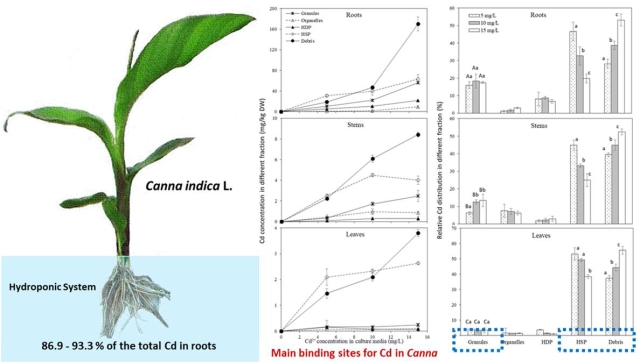
    The growth pictures of Canna indica L under 0, 5, 10, 15 mg/L Cd treatment.

    Key words:Cadmium; phytotoxic effects; chlorophyll; accumulation; subcellular distribution

    Volume:185

    Page:1-8

    Journal:ECOTOXICOLOGY AND ENVIRONMENTAL SAFETY

    https://doi.org/10.1016/j.ecoenv.2019.109692

    About Us

    • Brief Introduction
    • Address from the Director
    • Directors
    • Organization
    • IUE in Media

    Scientists

    • Academicians
    • Professors
    • Associate Professors

    Research

    • Research Divisions
    • Research Progress

    Education

    • Admission
    • Study at IUE
    • Scholarships

    INT'L Cooperation

    • INT'L Cooperation News
    • Partnership

    Papers

    Join Us

    • Job Opportunities
    • PIFI
    Copyright © Institute of Urban Environment,Chinese Academy of Sciences. All Rights Reserved.
    1799 Jimei Road, Xiamen 361021 China.+86-592-6190973.