


• Home
  • About Us
    • Brief Introduction
    • Address from the Director
    • Directors
    • Organization
    • IUE in Media
  • Scientists
    • Academicians
    • Professors
    • Associate Professors
  • Research
    • Research Divisions
    • Research Progress
  • Education
    • Admission
    • Study at IUE
    • Scholarships
  • INT'L Cooperation
    • INT'L Cooperation News
    • Partnership
  • Papers
  • Join Us
    • Job Opportunities
    • PIFI
      • What's PIFI
Contact Us   |   Sitemap   |   CAS   |   中文
  • Home
  • About Us
    • Brief Introduction
    • Address from the Director
    • Directors
    • Organization
    • IUE in Media
  • Scientists
    • Academicians
    • Professors
    • Associate Professors
  • Research
    • Research Divisions
    • Research Progress
  • Education
    • Admission
    • Study at IUE
    • Scholarships
  • INT'L Cooperation
    • INT'L Cooperation News
    • Partnership
  • Papers
  • Join Us
    • Job Opportunities
    • PIFI

Papers

  • HomePapers
  • Papers
    Decoupling the Dynamics of Bacterial Taxonomy and Antibiotic Resistance Function in a Subtropical Urban Reservoir as Revealed by High-Frequency Sampling
    Fang, PJ (Fang, Peiju); Peng, F (Peng, Feng); Gao, XF (Gao, Xiaofei); Xiao, P (Xiao, Peng); Yang, J* (Yang, Jun)

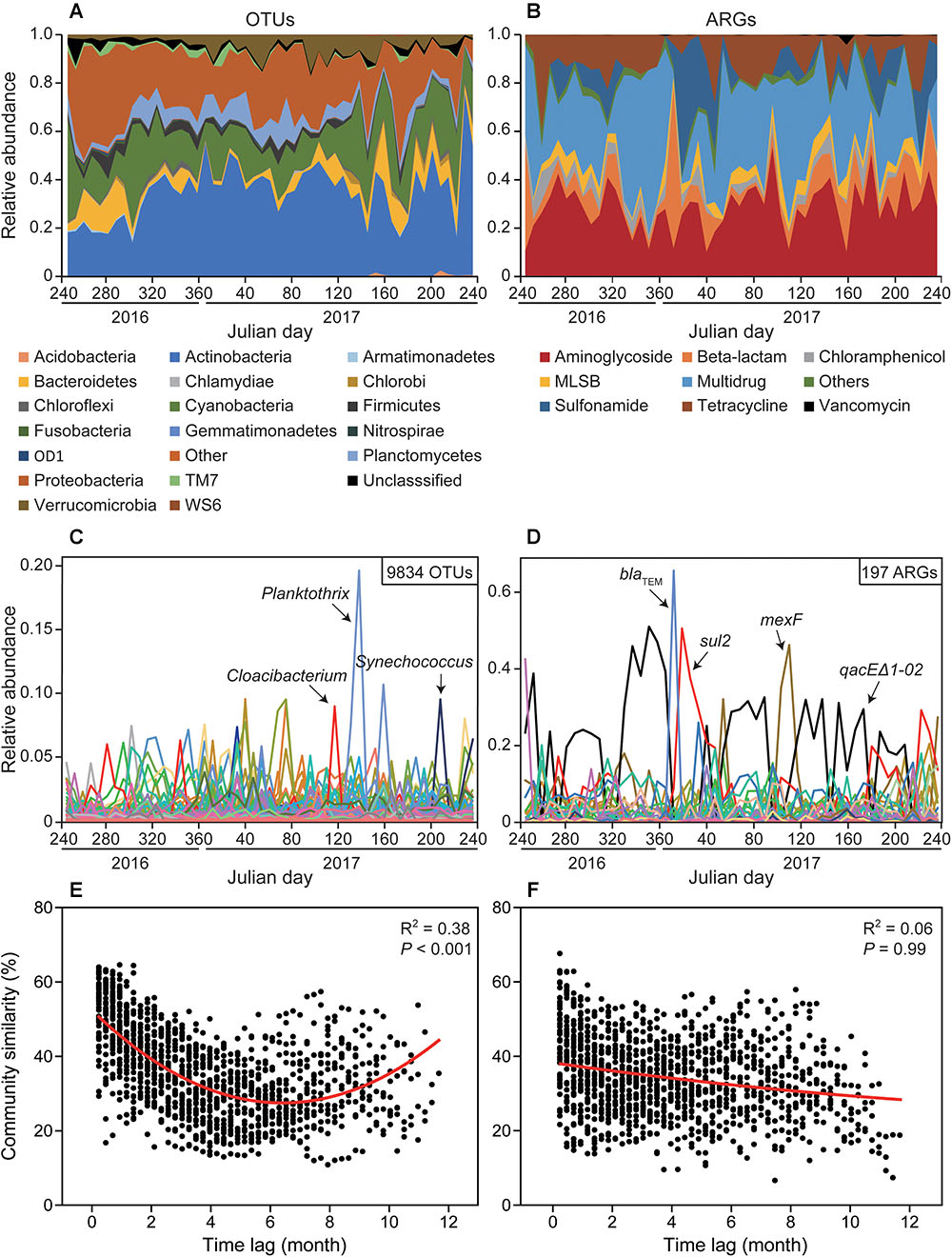
    Aquatic environments serve as important reservoirs of antibiotic resistance genes (ARGs), but the information on the high-resolution temporal pattern of ARGs in waterbodies is extremely limited. In this study, the weekly dynamics of ARGs and their relationships with microbial taxonomic communities and environmental variables were analyzed in a subtropical urban reservoir over the period of 1 year using high-throughput approaches. In total, 197 ARGs and 10 mobile genetic elements (MGEs) were detected. The results showed that the bacterial community had a seasonal pattern, while ARGs composition did not exhibit seasonality, thereby indicating the asynchrony or decoupling of temporal patterns of microbial taxonomy and function. More importantly, bacterial abundance and community diversity were more strongly correlated with 17 measured environmental variables than ARGs (36 significant correlations for OTUs, 11 for ARGs). However, stochastic processes appeared to have a minor role in the structuring of the ARG profiles, but a more important role in the structuring of bacterial taxonomic communities. Furthermore, we found that precipitation and turbidity were significantly correlated with the richness and diversity of ARGs, suggesting that multiple environmental factors influence the composition and dynamics of ARGs in complex ways. MGEs were abundant and showed significant positive correlations with ARGs, indicating a plausible influence of MGEs on the variation of ARGs. This is the first study which provides an overview of high-resolution dynamics of ARGs in a subtropical waterbody. Our results improve the understanding of microbial processes and mechanisms of ARGs at fine temporal scale, and offer empirical data of use in the monitoring, assessment and management of the urban water environments.
    Key words:antibiotic resistance genes; bacterioplankton; microbial community; high-resolution temporal pattern; subtropical reservoir

    Volume:10

    Page:1448

    Journal:FRONTIERS IN MICROBIOLOGY

    https://doi.org/10.3389/fmicb.2019.01448

    About Us

    • Brief Introduction
    • Address from the Director
    • Directors
    • Organization
    • IUE in Media

    Scientists

    • Academicians
    • Professors
    • Associate Professors

    Research

    • Research Divisions
    • Research Progress

    Education

    • Admission
    • Study at IUE
    • Scholarships

    INT'L Cooperation

    • INT'L Cooperation News
    • Partnership

    Papers

    Join Us

    • Job Opportunities
    • PIFI
    Copyright © Institute of Urban Environment,Chinese Academy of Sciences. All Rights Reserved.
    1799 Jimei Road, Xiamen 361021 China.+86-592-6190973.