


• Home
  • About Us
    • Brief Introduction
    • Address from the Director
    • Directors
    • Organization
    • IUE in Media
  • Scientists
    • Academicians
    • Professors
    • Associate Professors
  • Research
    • Research Divisions
    • Research Progress
  • Education
    • Admission
    • Study at IUE
    • Scholarships
  • INT'L Cooperation
    • INT'L Cooperation News
    • Partnership
  • Papers
  • Join Us
    • Job Opportunities
    • PIFI
      • What's PIFI
Contact Us   |   Sitemap   |   CAS   |   中文
  • Home
  • About Us
    • Brief Introduction
    • Address from the Director
    • Directors
    • Organization
    • IUE in Media
  • Scientists
    • Academicians
    • Professors
    • Associate Professors
  • Research
    • Research Divisions
    • Research Progress
  • Education
    • Admission
    • Study at IUE
    • Scholarships
  • INT'L Cooperation
    • INT'L Cooperation News
    • Partnership
  • Papers
  • Join Us
    • Job Opportunities
    • PIFI

Papers

  • HomePapers
  • Papers
    Assessing the Ecological Carrying Capacity Based on Revised Three-Dimensional Ecological Footprint Model in Inner Mongolia, China
    Wang, YN (Wang, Yening); Jiang, YT (Jiang, Yuantong); Zheng, YM (Zheng, Yuanmao); Wang, HW* (Wang, Haowei)

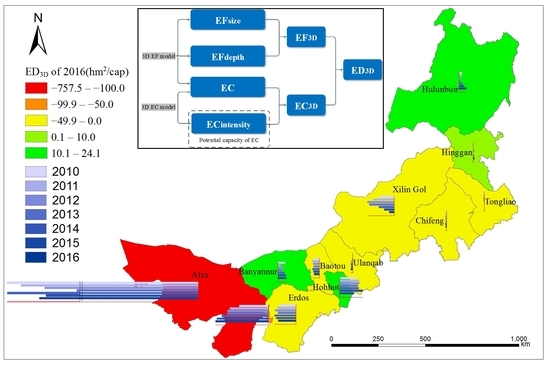
    Under the concept of green development, accurately mapping ecological carrying capacity to effectively evaluate regional sustainability has already become an important issue in China. This study introduced ecological carrying capacity intensity (ECintensity) based on the revised three-dimensional ecological footprint (3DEF) model to describe the temporal–spatial patterns of three-dimensional ecological carrying capacity (EC3D) in Inner Mongolia in 2010–2016 and to explore factors affecting socioeconomic sustainable development. The results showed that ecological footprint size (EFsize) differed between cities/leagues but changed little during the study period. Ecological footprint depth (EFdepth) far exceeded the original value of 1.00. Ecological carrying capacity (EC) varied in cities/leagues, while ECintensity increased slowly with stronger potential for regional development. Three-dimensional ecological deficits (ED3D) of cities/leagues were divided into five categories: Hohhot, Hulunbuir and Banyannur were in larger ecological surplus; Hinggan was in slight surplus; Baotou, Chifeng, Tongliao, Ulanqab, Xilin Gol and Erdos were in slight deficit; Wuhai was in stronger deficit; and Alxa was in severely intense deficit. Woodland of cities/leagues was continuously in slight ecological surplus, while cropland and grassland had crucial impacts on deficit. There was a significant positive linear correlation between gross domestic product (GDP) and footprint, while a negative correlation was seen with deficit. These results would help coordinate resource utilization and industrial structure adjustment in Inner Mongolia.
    Key words:ecological footprint size; ecological footprint depth; ecological carrying capacity; ecological carrying capacity intensity; three-dimensional ecological carrying capacity; Inner Mongolia Autonomous Region

    Volume:11

    Page:

    Journal:SUSTAINABILITY

    https://doi.org/10.3390/su11072002

    About Us

    • Brief Introduction
    • Address from the Director
    • Directors
    • Organization
    • IUE in Media

    Scientists

    • Academicians
    • Professors
    • Associate Professors

    Research

    • Research Divisions
    • Research Progress

    Education

    • Admission
    • Study at IUE
    • Scholarships

    INT'L Cooperation

    • INT'L Cooperation News
    • Partnership

    Papers

    Join Us

    • Job Opportunities
    • PIFI
    Copyright © Institute of Urban Environment,Chinese Academy of Sciences. All Rights Reserved.
    1799 Jimei Road, Xiamen 361021 China.+86-592-6190973.