


• Home
  • About Us
    • Brief Introduction
    • Address from the Director
    • Directors
    • Organization
    • IUE in Media
  • Scientists
    • Academicians
    • Professors
    • Associate Professors
  • Research
    • Research Divisions
    • Research Progress
  • Education
    • Admission
    • Study at IUE
    • Scholarships
  • INT'L Cooperation
    • INT'L Cooperation News
    • Partnership
  • Papers
  • Join Us
    • Job Opportunities
    • PIFI
      • What's PIFI
Contact Us   |   Sitemap   |   CAS   |   中文
  • Home
  • About Us
    • Brief Introduction
    • Address from the Director
    • Directors
    • Organization
    • IUE in Media
  • Scientists
    • Academicians
    • Professors
    • Associate Professors
  • Research
    • Research Divisions
    • Research Progress
  • Education
    • Admission
    • Study at IUE
    • Scholarships
  • INT'L Cooperation
    • INT'L Cooperation News
    • Partnership
  • Papers
  • Join Us
    • Job Opportunities
    • PIFI

Papers

  • HomePapers
  • Papers
    Peroxisome proliferator-activated receptor A/G reprogrammes metabolism associated with lipid accumulation in macrophages
    Ye, GZ (Ye, Guozhu); Gao, H (Gao, Han); Lin, Y (Lin, Yi); Ding, DX (Ding, Dongxiao); Liao, X (Liao, Xu); Zhang, H (Zhang, Han); Chi, YL (Chi, Yulang); Dong, SJ* (Dong, Sijun)

    Introduction

    Macrophage metabolism contributes to the progression of metabolic diseases, and peroxisome proliferator-activated receptors (PPARs) play vital roles in macrophage metabolism and the treatment of metabolic diseases. However, the role of PPARs in metabolic reprogramming related to lipid accumulation in macrophages, a key pathological event in metabolic diseases, remains unclear.

    Objectives

    We aimed to identify PPAR-mediated metabolic reprogramming and potential therapeutic targets associated with lipid accumulation in macrophages.

    Methods

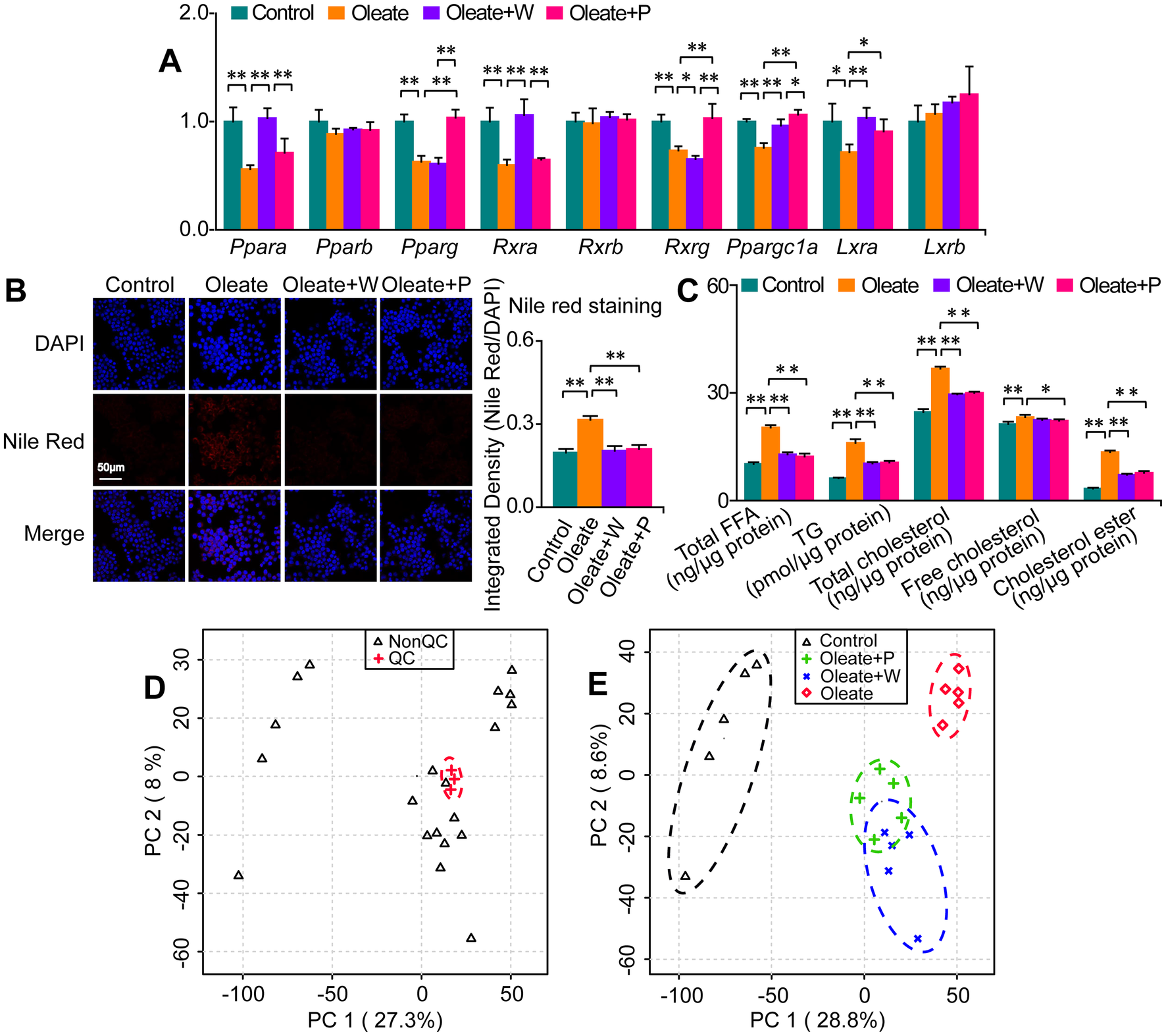
    Following treatment with oleate, oleate+WY-14643 and oleate+pioglitazone to induce alterations in PPAR signaling, lipids and relevant metabolism, macrophage samples were analyzed employing an untargeted metabolomics based on gas chromatography–mass spectrometry.

    Results

    The metabolomics approach revealed that multiple metabolic pathways were altered during lipid accumulation in oleate-treated macrophages and responsive to WY-14643 and pioglitazone treatment. Notably, levels of most metabolites involved in amino acid metabolism and nucleotide metabolism were accumulated in oleate-treated macrophages, and these effects were alleviated or abolished by PPARA/G activation. Additionally, during oleate-induced lipid accumulation and lipid lowering with WY-14643 and pioglitazone in macrophages, levels of most amino acids were positively associated with neutral lipid, total cholesterol, cholesterol ester, total free fatty acid and triglyceride levels but negatively associated with expression of genes related to PPARA/G signaling. Furthermore, glycine was found to be a potential biomarker for assessing lipid accumulation and the lipid-lowering effects of PPARA/G in oleate-treated macrophages.

    Conclusion

    The results of this study revealed a high correlation of amino acid metabolism with lipid accumulation and the lipid-lowering effects of PPARA/G in macrophages.
    Key words:Peroxisome proliferator-activated receptor; Macrophage; Metabolic reprogramming; Lipid accumulation; Amino acid; Nucleotide

    Volume:15

    Page:

    Journal:METABOLOMICS

    https://link.springer.com/article/10.1007/s11306-019-1485-6

    About Us

    • Brief Introduction
    • Address from the Director
    • Directors
    • Organization
    • IUE in Media

    Scientists

    • Academicians
    • Professors
    • Associate Professors

    Research

    • Research Divisions
    • Research Progress

    Education

    • Admission
    • Study at IUE
    • Scholarships

    INT'L Cooperation

    • INT'L Cooperation News
    • Partnership

    Papers

    Join Us

    • Job Opportunities
    • PIFI
    Copyright © Institute of Urban Environment,Chinese Academy of Sciences. All Rights Reserved.
    1799 Jimei Road, Xiamen 361021 China.+86-592-6190973.