


• Home
  • About Us
    • Brief Introduction
    • Address from the Director
    • Directors
    • Organization
    • IUE in Media
  • Scientists
    • Academicians
    • Professors
    • Associate Professors
  • Research
    • Research Divisions
    • Research Progress
  • Education
    • Admission
    • Study at IUE
    • Scholarships
  • INT'L Cooperation
    • INT'L Cooperation News
    • Partnership
  • Papers
  • Join Us
    • Job Opportunities
    • PIFI
      • What's PIFI
Contact Us   |   Sitemap   |   CAS   |   中文
  • Home
  • About Us
    • Brief Introduction
    • Address from the Director
    • Directors
    • Organization
    • IUE in Media
  • Scientists
    • Academicians
    • Professors
    • Associate Professors
  • Research
    • Research Divisions
    • Research Progress
  • Education
    • Admission
    • Study at IUE
    • Scholarships
  • INT'L Cooperation
    • INT'L Cooperation News
    • Partnership
  • Papers
  • Join Us
    • Job Opportunities
    • PIFI

Papers

  • HomePapers
  • Papers
    Characteristics and Source Apportionment of Volatile Organic Compounds for Different Functional Zones in a Coastal City of Southeast China
    Baoye Hu, Zhigang Yi, Jinsheng Chen*, LinglingXu, Zhenyu Hong, Youwei Hong*

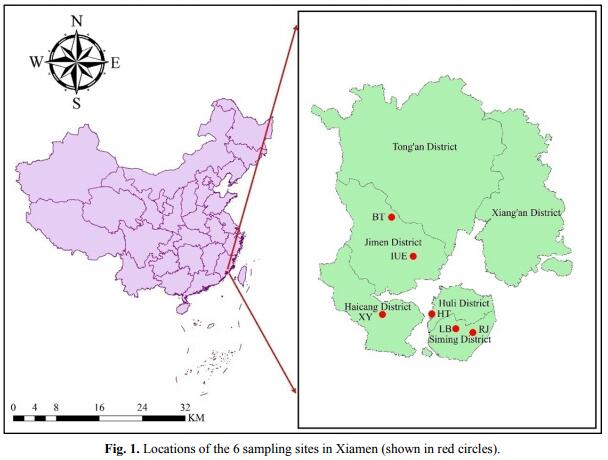
    Volatile organic compounds (VOCs) are the key precursors of tropospheric ozone and contributors to the formation of secondary organic aerosols (SOAs). VOCs from six functional zones in a coastal city in China were collected via SUMMA canister and determined via gas chromatography-mass spectrometry (GC-MS). The average annual concentrations of the total VOCs (TVOCs) were as follows: background site (36.00 μg m-3) < residential site (48.71 μg m-3) < port site (61.09 μg m-3) ≈ development site (62.25 μg m-3) < traffic site (73.82 μg m-3) < industrial site (98.33 μg m-3). The concentrations of TVOCs in spring and summer were higher than in autumn and winter. The ozone formation potentials (OFPs) were calculated, and the results indicated that 1-butene exhibited the highest OFP in the residential zone, while toluene exhibited the highest value in the other functional zones. The ratio of xylene to ethylbenzene was used to analyze the aging of atmospheric VOCs at the background site, which was affected by air pollution transported from urban areas. The sources of VOCs, namely, vehicle exhaust, fuel evaporation, biomass burning, industrial processes, and coal combustion, were identified with the Positive Matrix Factorization (PMF) model. Vehicle exhaust represented the largest source of atmospheric VOCs for every season, ranging 22.41-38.95%; additionally, the percentage of fuel evaporation increased in summer, reaching as high as 25.94%. The contributions of biomass burning were larger in autumn (21.11%) and winter (18.01%) than in spring (11.23%) and summer (16.94%), probably reflecting crop straw burning in the later seasons. Vehicle exhaust was the dominant source of VOCs (30.04–44.39%) in all functional zones, except for the residential site, which received its largest contribution (36.20%) from fuel evaporation.
    Key words:Volatile organic compounds; Source apportionment; Ozone formation potential; Positive matrix factorization; Coastal city.

    Volume:18

    Page:2840-2852

    Journal:Aerosol and Air Quality Research

    http://www.aaqr.org/doi/10.4209/aaqr.2018.04.0122

    About Us

    • Brief Introduction
    • Address from the Director
    • Directors
    • Organization
    • IUE in Media

    Scientists

    • Academicians
    • Professors
    • Associate Professors

    Research

    • Research Divisions
    • Research Progress

    Education

    • Admission
    • Study at IUE
    • Scholarships

    INT'L Cooperation

    • INT'L Cooperation News
    • Partnership

    Papers

    Join Us

    • Job Opportunities
    • PIFI
    Copyright © Institute of Urban Environment,Chinese Academy of Sciences. All Rights Reserved.
    1799 Jimei Road, Xiamen 361021 China.+86-592-6190973.