


【Economic Daily】 How Can Waste-to-Energy Plants Reduce Emissions and Increase Efficiency
Date:Dec 04, 2025
Recently, the full-scale excavation and remediation of Yulong Landfill, the largest landfill in China by volume located in Shenzhen, Guangdong, has drawn significant attention. This 110-meter-high "waste mountain" is being excavated at a rate of over 6,000 cubic meters per day, with more than 5,000 tons of waste sorted daily. The waste is then incinerated for power generation, capable of meeting the annual electricity demand of 26,000 households.
Why is the waste being dug up and burned? Are previous online claims about a shortage of waste for incineration and waste-to-energy plants competing for waste true? What is the current development status of the waste incineration power generation industry? A reporter recently investigated these questions.
Strong Processing Capacity
"The excavation of the landfill is not due to a shortage of waste for incineration, but rather for environmental remediation of the former waste mountain," explained a relevant official. The Yulong Landfill environmental remediation project serves as a development model of "environmental governance plus development and construction." It is also a vivid practice of shifting from dependency on incremental growth to tapping into existing potential, transforming environmental liabilities into ecological assets.
For Yulong Landfill, the significance of environmental remediation outweighs that of waste-to-energy. So, does the waste incineration power generation industry currently face a shortage of waste? The reporter learned that some incineration plants are indeed experiencing a situation of "underfeeding." For example, a prefecture-level city in Shaanxi has four domestic waste incineration plants. One company's designed processing capacity is 180,000 tons per year, but its actual throughput is only a little over 60,000 tons.
In some regions, the increase in the number of waste-to-energy plants has driven the transition of waste treatment towards resource utilization and harmless disposal, making landfill treatment unnecessary. It is reported that by the end of 2023, all 135 domestic waste landfills in Henan Province had been closed and decommissioned, making it the first province in China to achieve "zero landfilling" for primary urban domestic waste across the entire province.
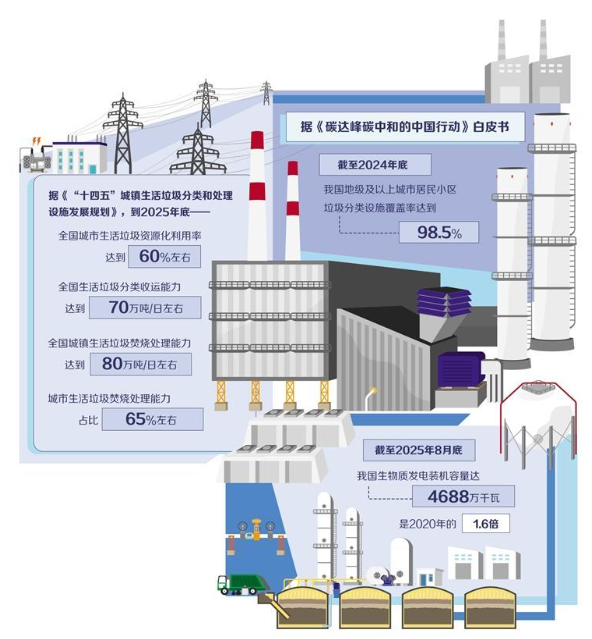
Data from the Ministry of Ecology and Environment shows that as of October 2024, there were 1,010 incineration enterprises nationwide, with 2,172 incinerators and an incineration capacity of approximately 1.11 million tons per day, exceeding the goals set in the 14th Five-Year Plan.
At the same time, the distribution of waste incineration processing capacity varies regionally. According to the Automatic Monitoring Data Public Platform for Waste-to-Energy Plants launched in January 2020, most of China's waste incineration plants are concentrated in economically developed or densely populated areas, showing a distinct characteristic of geographical concentration.
Huang Qunxing, Vice Dean of the College of Energy Engineering at Zhejiang University, believes that the waste incineration processing capacity is unbalanced nationwide. In the future, domestic waste incineration facilities should be utilized for the synergistic disposal of various solid wastes, including municipal sludge and industrial solid waste, allowing them to play a more comprehensive role. Zhejiang Province's publication in 2023 of the first list of general industrial solid wastes for synergistic disposal in domestic waste incineration facilities (clearly specifying seven categories of solid waste, including sludge, food residue, and recyclable waste, that can be co-processed) is a good practical example.
Lu Qiang, Executive Director of the National Engineering Research Center for New Energy Power Generation at North China Electric Power University, believes that "insufficient waste for incineration" is a phenomenon accompanying over-investment. A low waste calorific value or a high proportion of non-combustible materials can reduce furnace combustion stability and affect power generation efficiency. Even if the total volume is sufficient, "incomplete combustion" may occur. "This problem needs to be solved by improving waste classification, increasing the proportion of combustible waste, and blending waste from different sources," Lu said.
Classification is Crucial
With the continuous increase in waste incineration processing capacity, some believe that domestic waste can simply be "disposed of by burning." In reality, waste classification focuses on extracting the "resource" value of waste, as the composition of domestic waste is complex and not all of it is suitable for incineration.
For waste-to-energy plants, the significance of waste classification is immense. "The biggest benefit is the increase in calorific value, the reduction of harmful substances generated during incineration, and the improved efficiency of converting waste into green electricity. Without classification, the calorific value is too low, affecting the furnace temperature, and additional fuels like natural gas are needed to support combustion," said Dong Zhifei, Deputy General Manager of the Beijing Environmental Sanitation Group's Anding Circular Economy Park Branch.
Dong Zhifei explained that after waste enters the park, it must first undergo 5 to 7 days of fermentation in the waste storage pit to leach out moisture and increase its calorific value before it can be fed into the incinerator for normal combustion. During incineration, temperatures of 850°C to 1100°C must be reached to reduce the production of harmful gases like dioxins. After the waste is fully combusted, the remaining bottom ash is transported to the park's bottom ash resource utilization site, where valuable metals such as copper, iron, and aluminum are separated for resource utilization. This achieves a relatively high rate of waste resource utilization.
Wang Peng, a researcher at the Institute of Urban Environment, Chinese Academy of Sciences, explained that China's domestic waste collection system is gradually transitioning from mixed collection to classified collection, generally adopting a four-level collection and transportation model involving "bins, trucks, transfer stations, and plants." The composition of domestic waste is extremely complex and varies significantly with factors such as region, season, and economic development level. For instance, in summer, due to an increase in perishable waste like fruits and vegetables, the organic content and moisture in the waste are higher, which affects the calorific value and combustion characteristics, thereby impacting the incineration efficiency. When the waste calorific value is too low, auxiliary fuel must be co-fired to maintain stable furnace temperatures, which not only increases operating costs but also directly affects the energy recovery efficiency and economic benefits of incineration power generation.
Wang Peng emphasized that waste classification is a prerequisite for waste-to-energy to fully leverage its advantages. It allows for graded disposal, reduces the incineration burden, minimizes the mixing of harmful and non-combustible materials, and increases calorific value and incineration efficiency. Without precise front-end classification, efficient end-of-pipe incineration and energy recovery cannot be achieved. Inadequate waste classification also limits energy conversion efficiency. Domestic waste that hasn't been sufficiently classified, due to its high kitchen waste proportion, high moisture content, and low calorific value, can reduce combustion efficiency and increase the risk of unstable energy conversion.
However, Chen Dezhen, a professor at Tongji University and former Director of the Institute of Thermal and Environmental Engineering, believes that current waste incinerators can also burn mixed domestic waste. From a purely operational perspective, waste classification might not be necessary. However, considering resource recovery and efficient utilization, incineration after waste classification is beneficial for enhancing energy and environmental benefits.
Some regions have made beneficial attempts at waste classification. For example, the Southern Domestic Waste Incineration Power Plant in Zhangzhou City, Fujian Province, uses a comprehensive waste sorting and blending system to improve the calorific value and combustion stability of the waste fed into the incinerator, thereby increasing power generation efficiency and reducing pollutant emissions.
"Waste classification aims to build a resource-conserving society, separate hazardous waste, and resourcefully utilize valuable components. Even if there is no better destination for the waste after classification, the waste incineration plant serves as a fallback option," Huang Qunxing said.
Industry Exploration
After more than 30 years of development, China's waste incineration industry has progressed from experimentation to innovation, from concentrated efforts to address shortcomings to capacity surplus, leading the world in development speed. However, the industry also faces multiple challenges and constraints.
On one hand, the public's "NIMBY (Not In My Backyard) effect" towards waste-to-energy plants persists, leading to plants often being sited in relatively remote areas. This makes it difficult to integrate and utilize the generated residual heat and energy within nearby networks, resulting in significant waste of residual heat and low overall energy conversion efficiency. On the other hand, waste-to-energy projects have long investment payback periods, putting cash flow pressure on investment and operation parties. During the project initiation and equipment selection stages, equipment with lower initial costs and efficiency is often chosen. Project benefits rely on government subsidies; if subsidies are reduced or delayed, it can trigger financial risks.
Furthermore, the levels of flue gas purification, harmless treatment, and resource utilization of bottom ash and fly ash still need improvement. Small and medium-sized cities face challenges in funding and professional operation and maintenance teams due to high construction investment and operation/maintenance costs, limiting the scope of promotion. Moreover, public acceptance is also a significant constraint on widespread application.
It is understood that various regions are actively exploring solutions to related issues. For example, the Shenzhen Eastern Environmental Power Plant, the world's largest single-site waste-to-energy plant, uses advanced mechanical grate incineration lines and efficient flue gas purification systems. Its dioxin emission concentration is far below EU standards. The plant also enhances public acceptance and mitigates the NIMBY effect through architectural beautification and open tours. The Beijing Environmental Sanitation Group's Anding Circular Economy Park is also equipped with efficient flue gas purification systems, achieving clean pollutant emissions.
Additionally, the optimization of grate firing combustion technology has improved combustion efficiency. Wang Peng noted that over the past 20 years, the average energy conversion efficiency of waste-to-energy plants in China has shown a steady upward trend. However, significant efficiency differences still exist between different cities. He suggested that local authorities should formulate targeted waste classification standards based on regional characteristics, promote equipment technology upgrades, and systematically optimize objectives such as waste disposal, pollution control, carbon emissions, and energy output.
"Promoting industry progress requires a multi-pronged approach. In terms of pollution control, continuously improve flue gas purification, fly ash, and bottom ash treatment technologies, strictly implement emission standards, and promote comprehensive utilization of residual heat and district heating to enhance energy efficiency and environmental protection levels. In terms of promotion and public communication, governments and enterprises should proactively demonstrate the safety and environmental performance of modern incineration technologies, enhancing social acceptance through science education and plant open days. In terms of strengthening core technologies, focus on overcoming key technologies such as furnace optimization, combustion control, and intelligent operation and maintenance to improve power generation efficiency and system stability," Lu Qiang said.